
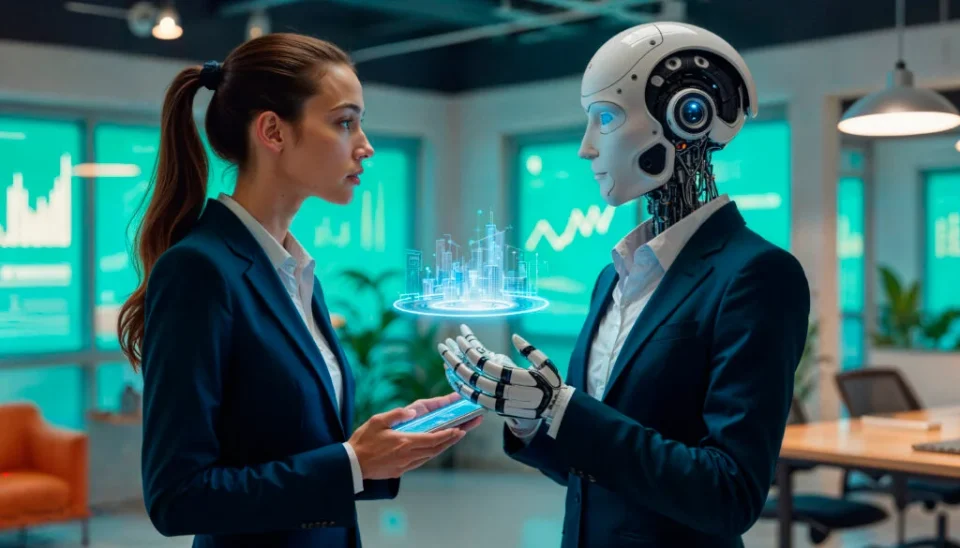
For much of industrial and digital history, technology functioned primarily as a subordinate tool. Humans input explicit commands, and machines executed deterministic routines. Whether operating a mechanical loom, typing formulas into a spreadsheet, or programming robotic arms for assembly lines, the division of labor remained absolute: humans provided the intent, reasoning, and context, while machines provided brute force and computational execution.
Today, this paradigm is undergoing a fundamental structural transformation. Advances in multimodal artificial intelligence, contextual natural language processing, edge computing, sensor miniaturization, and adaptive robotics are shifting machines from passive instruments into active, bidirectional collaborators. The emerging era of human-machine collaboration is not defined by total automation or the replacement of human labor. Instead, it is characterized by symbiotic co-working models where human cognitive nuance, strategic judgment, and ethical oversight combine with machine speed, pattern synthesis, and tireless precision.
The Shift from Automation to Augmentation
Traditional automation seeks to remove human intervention entirely to minimize friction, error, and labor costs. While effective for repetitive, low-complexity tasks, full automation encounters severe limitations in dynamic, open-ended environments where ambiguity is high.
Augmentation, by contrast, focuses on expanding human capabilities rather than eliminating human participation. The next generation of collaborative technology adopts this philosophy across three core dimensions:
-
Cognitive Amplification: Algorithms synthesize millions of unstructured documents, sensor data streams, or complex codebases in seconds, presenting humans with distilled patterns, anomalies, and multi-scenario projections rather than raw, unmanageable data.
-
Continuous Contextual Awareness: Modern systems maintain situational context over extended projects. Rather than treating each user prompt as an isolated event, collaborative software retains institutional memory, project goals, and conversational history to anticipate downstream needs.
-
Bidirectional Communication: Instead of requiring rigid programming syntax, interaction takes place via natural language, gestures, spatial gaze, and tactile feedback. This allows the human operator to guide digital systems intuitively, while the system can request clarification, provide status updates, or flag potential edge cases.
Core Pillars Powering Next-Generation Collaboration
The rapid convergence of several hardware and software innovations is creating the infrastructure needed for fluid, safe, and productive collaboration across diverse work environments.
Autonomous and Context-Aware AI Agents
Early digital assistants could only perform discrete, single-step tasks on command. Modern autonomous agents are capable of goal-oriented execution. Given a high-level strategic objective—such as optimizing a supply chain route during extreme weather or debugging a complex software pipeline—an agent can decompose the objective into subtasks, execute preliminary actions, retrieve relevant resources, verify intermediate results, and present human supervisors with completed workflows or high-stakes decision gates.
Collaborative Robotics in Physical Workspaces
Industrial robotics once required heavy safety cages to isolate high-speed machines from vulnerable human operators. Modern collaborative robots, often called cobots, are engineered with advanced force sensors, computer vision, and proximity detection.
These physical systems operate side-by-side with human workers on factory floors, logistics centers, and surgical suites. If an operator touches a cobot or steps unexpectedly into its path, the machine instantly decelerates or halts. This allows humans to handle delicate, dexterity-heavy assembly tasks while the cobot holds heavy components, applies steady torque, or completes repetitive fastening sequences.
Multimodal and Ambient Interfaces
Interacting with technology through keyboards and flat computer screens creates an ergonomic and cognitive bottleneck. Next-generation systems rely on multimodal inputs, integrating voice transcription, eye-tracking sensors, and spatial computing headsets.
In field engineering, for example, a technician wearing augmented reality glasses can inspect high-voltage electrical infrastructure while an AI system highlights internal wiring schematics directly over the physical machinery. The technician gives vocal commands to pull up diagnostic reports without ever putting down their physical tools.
Transforming Key Sectors
The integration of intelligent, cooperative machines is restructuring traditional workflows across every major knowledge and manual domain.
Modern Healthcare and Surgical Assistance
In clinical medicine, collaborative systems act as continuous diagnostic and surgical co-pilots. Radiologists use machine vision algorithms to scan thousands of cross-sectional scans, pre-flagging microscopic microcalcifications or subtle tissue densities that might escape human review during long shifts.
In operating rooms, robotic surgical systems translate the surgeon’s hand movements into micro-movements inside the patient’s body, filtering out natural hand tremors and offering three-dimensional, magnified visualization. The surgeon retains total authority over every surgical cut, while the robotic interface ensures unparalleled mechanical precision and reduces tissue trauma.
Engineering, Architecture, and Generative Design
In architectural and structural engineering, generative design platforms work alongside human creators. An architect inputs structural constraints, weight parameters, local building codes, and environmental loads into a design engine.
The software generates thousands of viable, biomimetic structural designs that optimize material efficiency beyond conventional human drafting habits. The engineer then applies aesthetic taste, budget parameters, and material feasibility to select and refine the ultimate structure.
Software Engineering and Pair Programming
Software development is shifting toward continuous collaborative programming. AI coding systems act as virtual junior partners, autocompleting repetitive code structures, writing comprehensive test suites, translating legacy code into modern frameworks, and auditing dependencies for security vulnerabilities in real time.
This partnership frees human developers to focus on architectural strategy, systems logic, user experience design, and business requirements.
Managing the Sociotechnical Challenges
While the benefits of human-machine integration are vast, building sustainable collaboration requires navigating significant organizational, cognitive, and ethical hurdles.
-
Avoiding Automation Complacency: When collaborative tools operate with high accuracy, human overseers can fall into passive monitoring modes, missing subtle machine errors or algorithmic hallucinations. Systems must be designed with active friction points that require meaningful human verification.
-
Explainability and Algorithmic Trust: Professionals cannot confidently act on machine recommendations if the underlying logic is a total black box. Machine partners must provide interpretable rationales, source attributions, and clear confidence scores for their outputs.
-
Data Sovereignty and Privacy: Collaborative systems require access to vast amounts of operational and personal data to remain contextually relevant. Organizations must establish strict data boundaries to ensure proprietary intellectual property and sensitive user data remain protected.
-
Workforce Reskilling and Cultural Adaptation: Successful adoption depends on training workforces to become effective prompters, managers, and auditors of digital collaborators. Organizations must invest in digital literacy programs to eliminate fear and build institutional fluency.
Frequently Asked Questions
What distinguishes a collaborative robot from a traditional industrial robot?
Traditional industrial robots are high-powered, rigid machines programmed to execute repetitive tasks at maximum speed inside isolated safety enclosures, as direct contact with a human could cause fatal injury. Collaborative robots are built with integrated force-limiting sensors, soft edges, and advanced vision systems that allow them to safely share a physical workspace with human personnel, stopping immediately upon touching an unexpected object.
How does human-in-the-loop design prevent automated system failure?
Human-in-the-loop architecture ensures that autonomous algorithms do not make final, irreversible decisions in high-consequence scenarios without human sign-off. By establishing explicit checkpoints where a human expert must review, validate, or override machine recommendations, organizations prevent widespread systemic errors, maintain accountability, and capture subtle edge cases that machines are not trained to handle.
Does increased collaboration with AI diminish human critical thinking skills?
If systems are designed purely to replace human cognition, intellectual atrophy can occur. However, when systems are structured to serve as cognitive scaffolding—challenging human assumptions, proposing diverse alternatives, and taking over rote administrative tasks—they enable professionals to spend more time on deep analysis, complex problem solving, and higher-level synthesis.
What is the role of digital twins in human-machine cooperation?
A digital twin is a dynamic, virtual replica of a physical asset, process, or system that updates continuously using real-time sensor data. Human managers and machine intelligence use digital twins collaboratively to run predictive simulations, test hypothetical stress conditions, and model operational modifications safely in a software sandbox before applying changes to the real-world environment.
How do modern collaborative tools handle ambiguous or conflicting human instructions?
Next-generation systems use contextual natural language models to evaluate the intent and feasibility of an instruction against historical operating parameters. When an instruction is ambiguous, contradictory, or structurally risky, the machine flags the logical conflict and prompts the user with clarifying questions or alternative paths before executing the command.
How can organizations measure the return on investment of collaborative systems?
Return on investment for collaborative platforms extends beyond simple head-count reductions. Organizations measure success through metrics such as reduced project turnaround times, lower error and defect rates, accelerated employee onboarding cycles, improved worker safety records, and higher employee retention resulting from the removal of repetitive, low-value administrative burdens.
What ethical frameworks should govern human-machine co-working environments?
Ethical deployment frameworks require absolute transparency regarding when and how automated systems influence decisions, clear lines of human accountability for systemic errors, regular audits to detect and eliminate algorithmic bias, and strict data governance policies to protect worker surveillance data from being misused for punitive performance tracking.
